
How parents in the South are organizing to support their trans kids
Photographer: Nora Dayton (she/her)
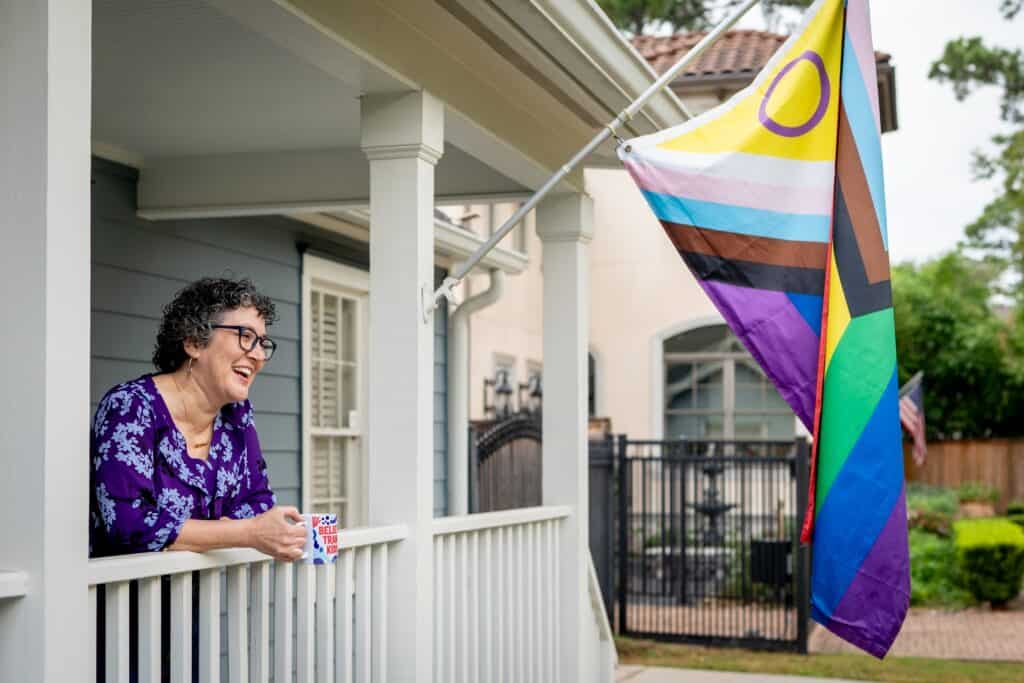
Mandy Giles on her veranda in Houston, TX.
In the face of limiting legislation, many families with trans children are advocating and creating alternative spaces across the South. Others fear they will have to leave.
Mandy Giles remembers the exact moment the first of her twins, Indigo, told her they were trans.
“I was at the kitchen sink, I had the rubber gloves on doing dishes, and they came up to me and said, ‘Mom, will you buy me a binder?’ And I was like, ‘Yeah, do you need it tonight? Office Depot maybe is still open until 9…’”
Indigo said, “No, Mom,” and then explained what a chest binder was and why they wanted it.
“I was confused,” Giles says. “I didn’t know anything about that identity.”
Standing in the same kitchen in Houston where they raised their three children — nonbinary trans twins and their younger brother — Mandy and Neil Giles are the picture of a kindly Christian Texan couple. They chat over coffee and kolaches in front of a wall of decorative crosses while their golden retriever runs around the living room.
Out front, they fly a queer, trans, and intersex flag for the neighbors to see. The twins, Indigo and Mars, are now 23 and live a couple of hours away in Austin. In spite of their own conservative upbringings, over the last few years Mandy and Neil have become advocates for trans and nonbinary youth in public and private life.
The Giles family is part of a growing movement of parents of trans youth who have been activated by the rising anti-trans backlash. Trans children have been at the nexus of a huge amount of debate and politics for the last few years — and their parents, for the most part, are not having it. A 2024 Human Rights Campaign (HRC) survey found 92% of parents and caregivers were supportive of their trans kids. On top of that, half of the parents surveyed had participated in political advocacy on behalf of their kids, an astonishing number. But a majority of the parents surveyed in 2024 said they need more resources to help them support their kids, including help with advocating for children in school, and navigating health insurance and identity documents.
The evidence of this parent movement is everywhere. Organizations around the country, from the Campaign for Southern Equality and TransParent USA, to dozens of grassroots local groups are gathering parents together to help them affirm their transgender kids and support them as they figure out health care, school, and identity documents. Recent coverage in Capital B news shows how Black parents are rallying in support of their trans kids, and PFLAG has been publishing a series of profiles of parents who have changed their minds in favor of supporting their transgender children.
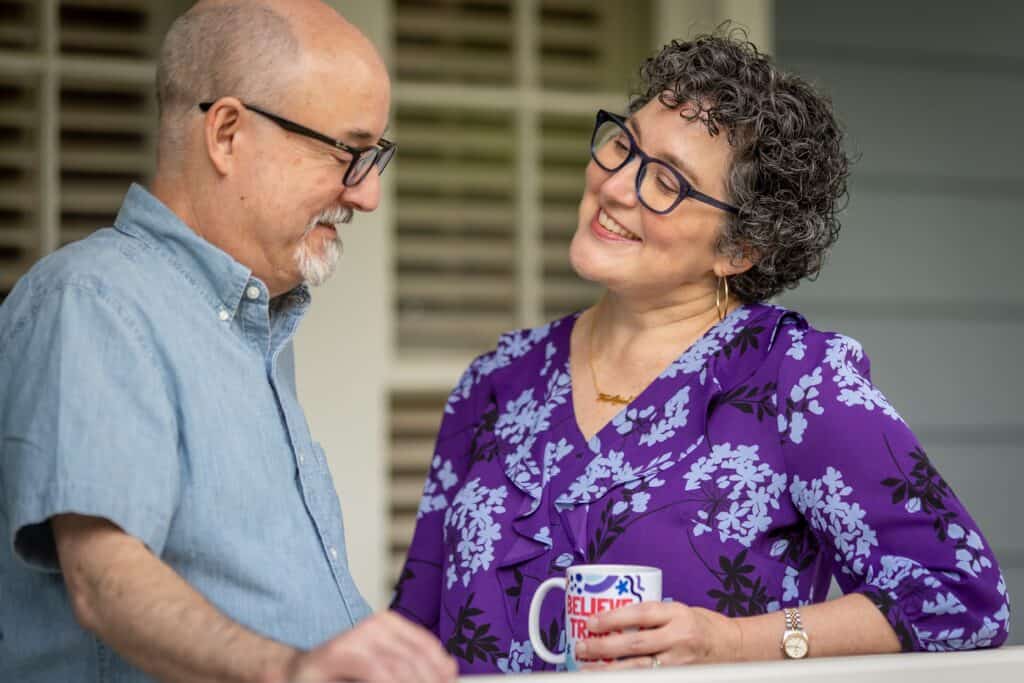
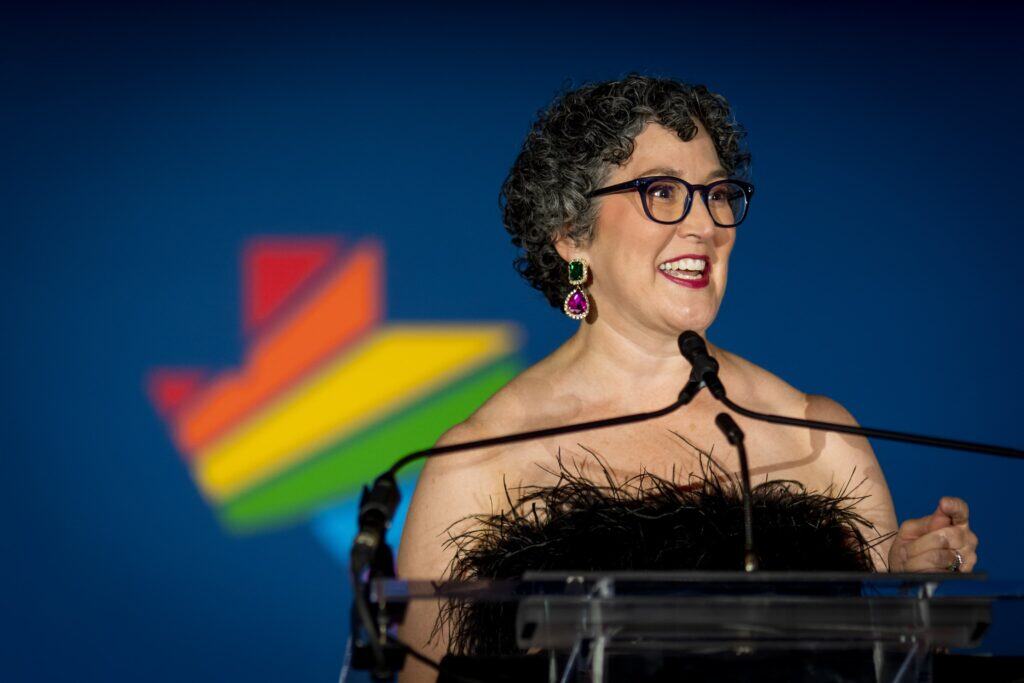
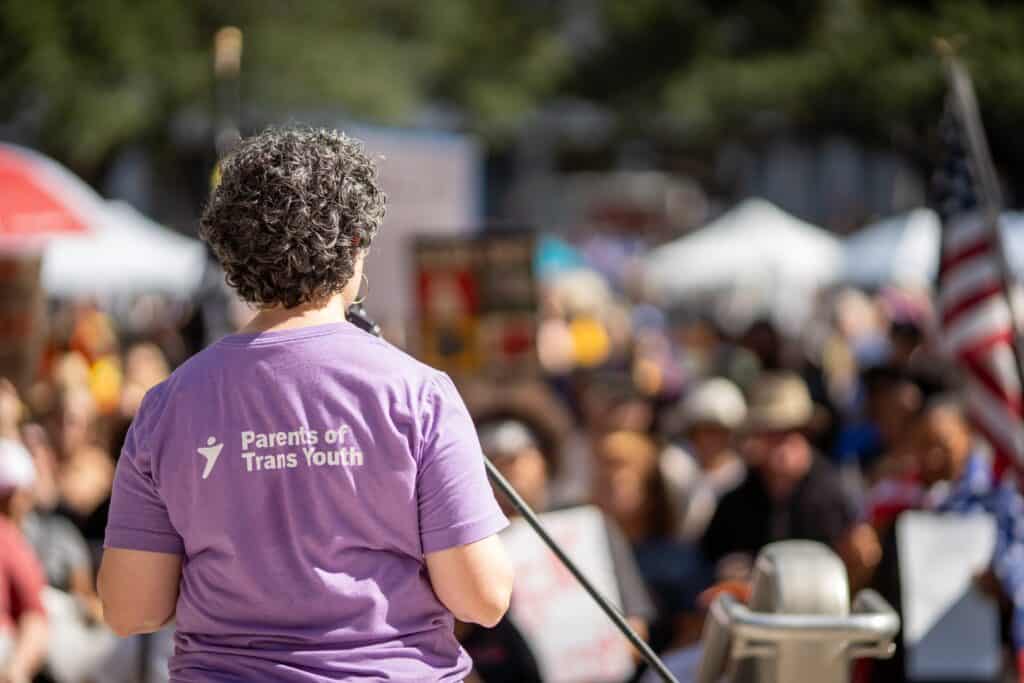
Mandy Giles, who was recently honored by Equality Texas for her activism and work with parents of trans kids, has been leading and guiding parents of trans kids for four years through her organization Parents of Trans Youth. Giles has a gentle smile and soft curls, a sweetness that is almost girlish. She has been trolled, threatened, and accused of grooming and abuse, but her own children motivate her. They are the ones who taught her what real support looks like.
When Indigo came out as bisexual in eighth grade, their parents immediately joined PFLAG to talk to other parents. When Indigo later came out as nonbinary, the Gileses initially wondered if it was just a phase, but they went back to PFLAG for help and quickly got useful information — particularly from and about transgender adults — that helped them put their kid’s story in perspective and focus on supporting rather than questioning them.
Then Mandy signed up for a trans conference called Gender Infinity — her first time in a truly trans space. “It was like stepping into an alternative universe that has always been there. At first it was weird for me…and then, that changed everything.”
In 2019, Giles started talking and working a lot with other parents of trans kids, and in 2020 she decided to leave her job in nonprofit fundraising to focus full-time on supporting trans kids. It took a lot of learning and conversation to sort out what this venture would look like, and what her role would be.
“I didn’t want to take up space where I shouldn’t, or didn’t belong…and I got some really good advice from trans adults: ‘Stay in your lane.’”
Photographer: Nora Dayton
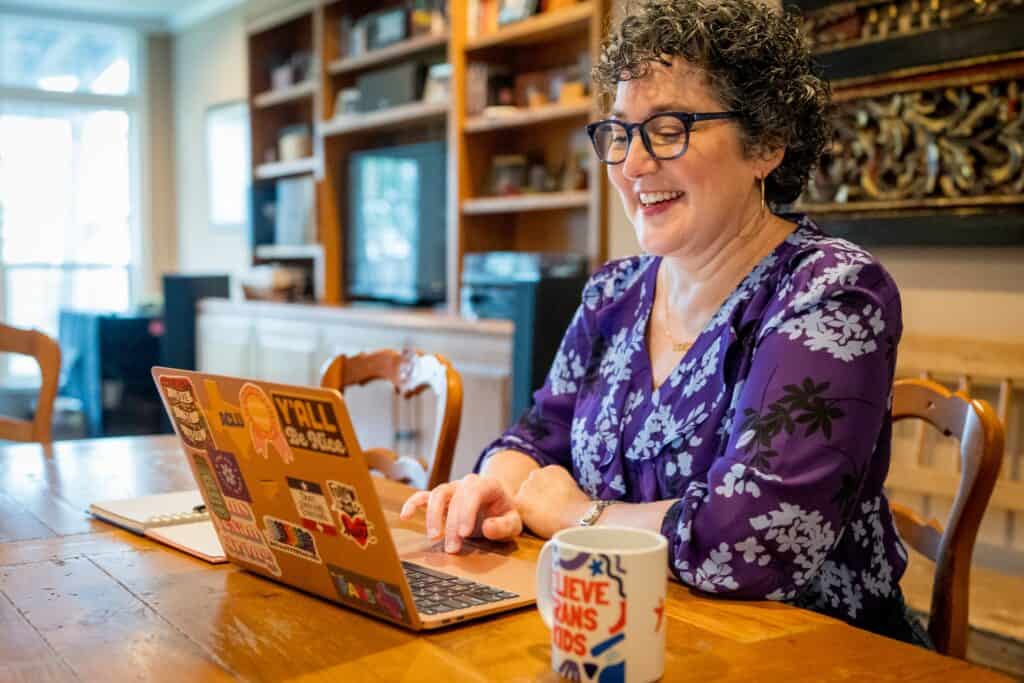
Mandy at work.

Photographer: Nora Dayton
Mandy and Neil.
In 2022, she launched Parents of Trans Youth, a business that provides support in a confidential and vetted online space; connects parents with one another through discussion boards and weekly live events; and shares resources about navigating health care, education, and advocacy. The social impact business now has 100 members, offers an online “Parents of Trans Youth 101” course, and produces a podcast about trans activism hosted by Giles.
Through these confidential support spaces and in-person support groups, Giles helps parents with the missing resources identified in the HRC survey: support around school, health insurance, identity documents, and how and when to disclose their kids’ gender identity to others. But direct political advocacy quickly became part of the picture, too.
“Two weeks after I launched, Governor Abbott issued his directive for the Department of Family and Protective Services to investigate families with trans kids in Texas,” she says. According to the Texas governor, supporting a person under 18 in their transition should be considered child abuse. That order set off a firestorm of reaction and fear, and also immediately triggered investigations of families by the department’s Child Protective Services division. These were put on hold by a court order in 2024, but in the interim, Giles said, it had a chilling effect. “I remember people thinking, ‘Is it okay to take my kid to the doctor? Will they take my child away?’”
Ironically, supporting a young person in their self-discovery and transition is likely to be the best thing an adult caregiver can do for their child’s safety. Studies have shown that kids who socially transition with their parents’ support show much lower levels of depression and anxiety than trans youth who aren’t able to be out. And family rejection or lack of support for LGBTQ+ people corresponds to increased risks of suicide and drug use, as well as higher chances of being unhoused.
Over time, both Mandy and Neil Giles realized that the ability to align one’s outer appearance with their inner feelings was a deep matter for both of their kids. Mars, Indigo’s twin, came out as nonbinary and trans as a freshman in college. In the process, the Gileses changed how they think about the world in general, and gender in particular. What if the ideals they’d been raised with, growing up in conservative Texas families, was wrong?
In telling the story of how his twins allowed him to challenge the beliefs he grew up with, Neil starts to cry. “That was the day my life changed. Because they had the courage to say, ‘Here’s why you’re wrong, Dad.’”
Mandy similarly feels like her own world has expanded after learning about her kids’ identities. Once she let go of some of her own deepest biases, other possibilities for rethinking rose up in their place. “Instead of thinking, ‘My world is gonna crumble’ — what if it opens?” she says.
Parents and kids are fighting a losing legislative battle — and finding workarounds
Before formally getting into advocacy work in 2021, Giles was involved more informally with supporting other parents of trans kids. But when Republicans brought a slate of anti-trans bills to the 2021 legislative session in Texas, she decided to get training from Equality Texas on how to testify at the capitol.
“I prepared a two-minute testimony in front of the house state affairs committee. That year, everything was about trans student athletes,” she said. When she heard the “hateful, horrible rhetoric” of their opposition, including that of some Texas lawmakers, “I saw a different side of what it meant to support your kid, and what it would mean for me in my work.”
Parents are following the lead of trans youth and adult organizers in the state: Texas Trans Kids distributes a students’ rights toolkit for trans kids, and provides legal updates for parents and youth. Trans Texas has an education campaign and an online bill tracker. The ACLU also has a students’ rights hub to support organizing around Texas schools.
“Every year, something happens — especially in the legislature,” she says. In 2021, bills targeted trans kids in sports; in 2022, Gov. Abbott launched the directive to investigate supportive families of trans children. During the 2023 legislative session, Texas made it illegal to provide gender-affirming medical care for youth under 18. That was when people started leaving, Giles says — either crossing state lines to access medical care, or moving out of state altogether. The health care restrictions were upheld by the Texas Supreme Court in 2024, and Texas passed seven new anti-trans bills in 2025. Now, Texas Attorney General Ken Paxton is suing providers who offer medical care to trans people, accusing them of fraud.
For all the hype and purported concern about the dangers of medical transition for people under 18, the actual numbers of youth to receive these services are tiny. According to a 2022 Reuters investigation, out of 42,167 youth who received diagnoses of gender dysphoria in 2021, just 1,390 started hormone blockers, and another 4,231 received hormone therapy.
The number of surgeries is even smaller: that year, 282 (less than one tenth of one percent of youth diagnosed with gender dysphoria) had double mastectomies. For a point of (imperfect) comparison, in 2022 the American Society of Plastic Surgeons reported performing 23,527 cosmetic surgeries on youth aged 19 and under.
A separate 2024 study found that 97% of gender-affirming chest reduction surgeries performed on minors in 2019 were for cisgender boys, for whom such surgeries are permitted without regulation.
Meanwhile, parents of minors have become increasingly afraid to speak out publicly because they could be accused of abuse and targeted for investigation. Giles says she only feels safe continuing to do her work because her kids are over 18. Between 2021 and 2023, she says, the numbers of parents testifying at the legislature plummeted. The legislature only meets every two years.
“A few families who had already been very public showed up,” she says. “But by 2025, most of the time I was the only parent who was there. It was me, maybe one other parent sometimes, and a bunch of amazing transgender people who would show up every time. It was mostly transgender people fighting for themselves.”
That group faced down literally hundreds of bills introduced in 2025, with multiple anti-LGBTQ+ bills coming up per day during the legislative session. Their work has become about holding off an avalanche.
“If I was tired and scared, I’m sure my trans friends were feeling that 100 times more,” Giles says. And civility is out the window in the legislature, too. The legislators themselves are “rude,” she says, “grilling citizens who showed up about their opinion” and attacking them verbally while they speak. “The hard part is, they can be as nasty as they want, but the citizens cannot be nasty back, or you’ll be thrown out.”
Even parents who are savvy and supportive struggle to keep up with all the laws and directives that might affect their children: new rules about passports, rules about what people can say or do in schools, and increasing medical restrictions, to name a few. Parents of Trans Youth tries to help with that, running a monthly in-person support group in Houston for parents to discuss whether to stay or go, and how to find resources. Other groups across the South are doing the same.
Building community for trans families in the South
At Queer Haven Books in Columbia, South Carolina, the state’s right-wing repression is markedly not on full display. The shop sells beer coozies that say “Fuck Trump,” sex-positive gag stickers, and children’s and young adult books that cover a full range of gender and sexuality education.
MM and MJ, a queer couple who chose to use their initials in order to protect their child’s identity, explain that this is where the monthly group for caregivers and parents of LGBTQ+ youth meets. MJ and another parent cofounded this group as a program of the Harriet Hancock Center, Columbia’s 32-year-old LGBTQ+ resource and community center. MJ says they encourage participants to see it as a “brave space.” When kids get called by the wrong names or pronouns, the adults hold each other accountable. They also teach each other about pronouns and identity, local resources for queer and trans youth, and how to better support their kids (most of whom are trans or nonbinary). The center has a high school and a middle school group; the caregivers meet during the middle school group time.
“I’ve learned a lot about how to create a safer space for people,” says MJ. They have a kid who has been identifying as nonbinary since they were six years old, two years ago. The couple describe their community in Columbia as beautiful and supportive — meeting in Queer Haven Books, tucked inside a downtown arcade, reinforces that cozy feeling. They go to a supportive church, and even their elementary school is “phenomenal,” they say. And they’ve always trusted their child. “They know themselves better than we do,” says MM.
The biggest challenge of having a nonbinary kid, the couple says, is dealing with people outside their immediate community: extended family and a hostile political environment.
“Honest to God, it feels like a lot of people are out to get our babies,” MJ says. “I’m gonna be damned before I let some grown-ass adult disrespect my child and not stand up to that. People need to get over themselves and touch grass. Find Jesus — the brown one. Go to therapy.”
Another South Carolina family, Rodney, Amber, and Marshall (also pseudonyms to protect minor children), meets me in full pride gear: Marshall, the 13-year-old, wears baggy black pants and a rainbow-striped button down. Amber shows up with a rainbow bracelet and Rodney wears a T-shirt with rainbow lettering that reads “Protect Queer Youth.”
“I’m a white male that looks very conservative,” Rodney says, so he wears rainbows to show people where he stands. Amber is bisexual. “I dated women all through high school until I found him,” she says. The couple agreed — before they even had children — that they would support their kids, no matter what. “There’s no kicking out of the house; there’s no separation.” They didn’t push gendered toys or clothes on their kids (they also have a 2-year-old); they want them to explore and choose for themselves.
Marshall came out as nonbinary in second grade. Initially, Amber and Rodney depended on online forums to find other nonbinary people, but once Marshall was a little older, they found community at the local LGBT center, where they became leaders in the parents’ group. Their public middle school has been very supportive, even though South Carolina officially bans trans kids from using bathrooms that align with their gender, and has a “forced outing” rule that requires school teachers to call parents if a student discusses their LGBTQ+ identity in school. Some of Marshall’s friends are afraid to be out at school, because they have families who are less accepting. Amber and Rodney welcome anyone to come and stay with them if they need a safer place to be.
“Our tiny house will take in as many kids as possible,” Amber says. “That’s what I hope our house becomes.”
The pair often brings Marshall and their little sibling to rallies at the statehouse. Even though the chances of winning over South Carolina’s conservative legislature are low, they want their kids to see how many people rally in support of trans and queer youth.
“It’s nervewracking, for sure,” Amber says. “But it shows that there’s more to this community than just our small group.”
Marshall likes normal teen stuff: Dungeons and Dragons, art class, and friends. Amber and I ask the 13-year-old what they worry about most.
“Getting hurt by strangers that don’t like who I am,” they respond immediately. “And kids or grown-ups agreeing with them.” Marshall has been bullied at the skating rink (Marshall’s parents subsequently switched rinks). Amber asks if they worry about that at school, and they say no, “due to my friend group being so big. It takes up half of the lunch table.”
The family just got their passports this year, in case they need to leave. They feel safe enough right now, but they’re aware of how quickly things could change. “The potential to have to leave the country is ever-present… Do we wait a little bit longer? Do we fight a little bit longer?”
When staying and fighting is the only choice
Maria Palacios, an artist and disability activist in Houston, will remain in the South. Palacios, 59, has raised her son’s kid — her 8-year-old grandchild, whom she considers her child — since infancy as their legal guardian. When this child started identifying as a “girl-boy” and later using he/they pronouns, it was easy for her.
“I grew up disabled and my body was controlled by the medical model, by other people…I grew up beating the odds,” she says. “My kid has the advantage of me being in the very center of this field of disability justice.” Her own political beliefs about bodily autonomy and self-determination made her immediately inclined to respect their identity.
“Disabled communities are very vast and beautiful,” she says, and she’s long had her own trans friends and community. “I didn’t push one way or the other.” Her kid was drawn to masculine clothes and names, and Palacios let him follow that desire. Her main concern is that society, kids at school, and media will shame him out of being himself. But at home, her kid is allowed to try what they want: “shaving” their face, experimenting with clothes and fake mustaches, and identifying with boyish TV characters.
“I have been super emphatic with body ownership,” Palacios says. “This is your body.”
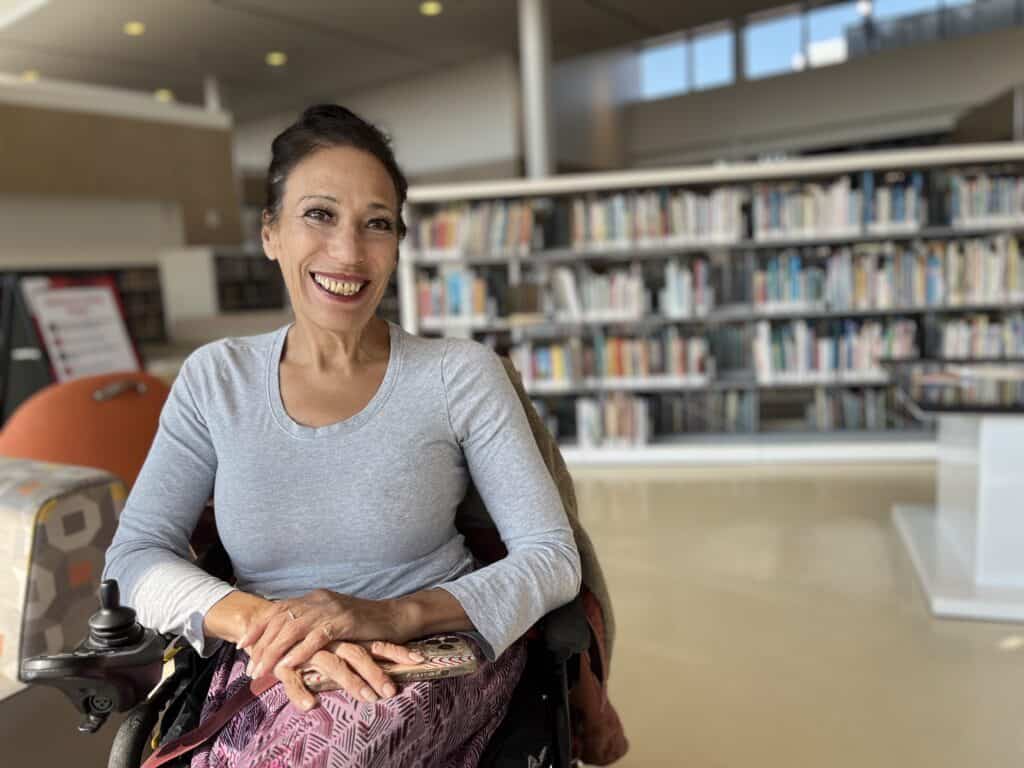
In Alief, a sprawling working-class neighborhood in Houston, her kid plays with a few cousins at the library and community center where they regularly hang out. Occasionally they appear close by, curiously eavesdropping on our conversation and their passionate and bright grandmother. But when we turn towards him, he’s suddenly shy, unsure of what to talk about.
“I like to jump on my trampoline, and I like to play soccer,” he says, then pulls back and returns to playing.
Palacios is concerned about what will happen when her grandchild hits puberty — Texas won’t allow people under 18 to access puberty blockers anymore, and the sex education in school is very gendered as well. “The advantage that I have is my kid is so aware about things that have to do with gender identity. Not all boys have a penis, for example. They know all this, and that’s power right there.”
Just up and leaving Texas is a privilege she doesn’t have. “I’ve been in Texas pretty much my whole life. As a disabled person, it’s not easy to just pick up and leave,” she says. “My financial security is here, with my kid being with family…if I leave, I would have to leave the country, probably. But shit for trans people is horrible no matter where you go.”
And Houston has been good to Palacios, whose mother first brought her here from South America as a teen to access medical care. They have community spaces to meet in, the kids like their schools, and they’re surrounded by supportive family.
“I’m not from white culture. White culture picks up and moves easier than we do. I’m totally a Latina: my sons live with me, my mom lives with me. But you know, I’m willing to do whatever it takes to protect my baby.”
Palacios says, in general, she’s not accustomed to responding from fear. “I’m a pretty gutsy person in a lot of ways. I am who I am, you know,” she says. But the authoritarian escalations of the current federal administration do have her on edge.
“Things are different now.”
ADDITIONAL RESOURCES FOR PARENTS OF TRANS CHILDREN AND YOUTH:
- PFLAG (Parents and Friends of Lesbians and Gays) is trans-inclusive and has dozens of chapters and online resources.
- Campaign for Southern Equality has an online support group and resources for navigating health care, including grants for families who need to travel to get gender-affirming care for their kids.
- Trans Parent USA has chapters in many states.
- Movement Advancement Project has an extensive resource list that includes resources specific to Black, API, Latinx, and religious families.
- The Erin in the Morning Substack reports daily on trans-related policy and legislation, and discussion groups for Substack members include many caregivers and parents.