
What it takes to create a living Black trans archive
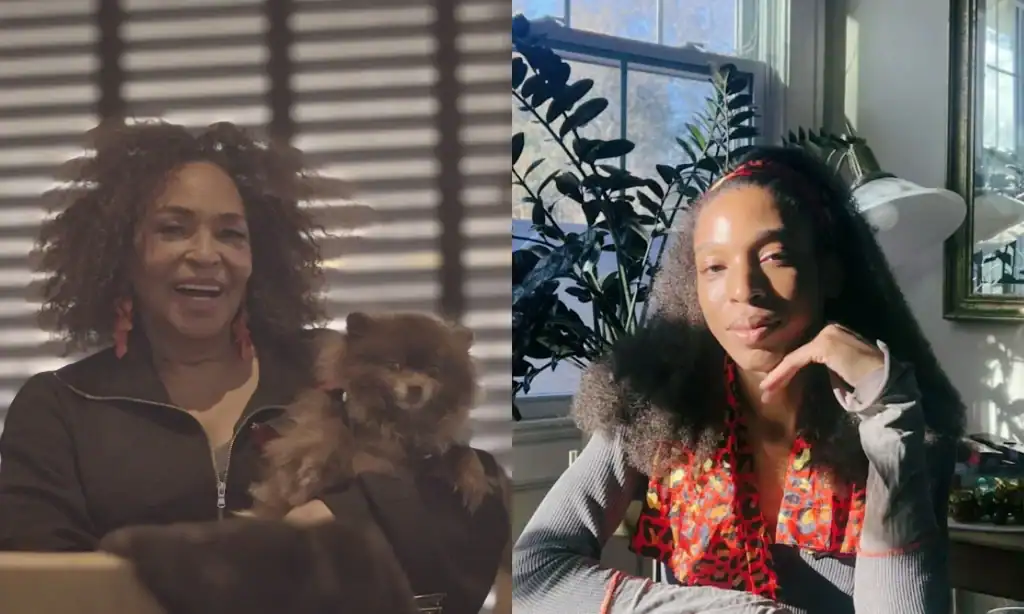
Community historians Andrea Horne (left) and Sultana Isham (right)
Community historians Andrea Horne and Sultana Isham are building archives that contextualize the lives of Black trans women and gender-nonconforming people from the 1800s to the 2010s.
An archive is never neutral. What is included on the record — as history — determines which stories and facts are legitimized, and what parts of collective memory shape the world around us. Andrea Horne is a San Francisco-based Black trans archivist and historian creating new guidelines for collecting, preserving, and sharing the stories of Black trans women and transfeminine people.
Horne’s work as an archivist began when she was just nine years old. Her uncle gifted her a book titled, “100 Amazing Facts About the Negro with Complete Proof,” by J.A. Rogers, originally published in 1934. She recalls reading it as “the moment you realize the whole world is lying to you.” This moment reshaped her whole sense of America — a country known to warp and erase the customs and culture of marginalized communities. But this early realization didn’t make her cynical, it made her determined. She began researching on her own, trying to locate herself, her people, and Black history in a country built on our disenfranchisement and disempowerment.
Horne calls this sense of understanding “the knowing.” When you know who you are and the people you’re descended from, you move through the world differently. You gain a steely strength and a voice that others may want to take away. That’s part of why archival work matters. It’s not just about remembering — it’s about protecting that knowing from being stolen.
Horne’s version of history is not detached, nor is it “objective” in the institutional way. Her authority comes from lived experiences, community research, public libraries, travel, her own lineage, and a refusal to let outsiders define Black trans women through stereotypes. She puts it plainly: “Black history is not a side dish. It is the spine of America. When people perform ignorance around this history, it is not naïveté — it is a deliberate choice to protect the dominant culture’s narrative at the expense of historical truth.” To Horne, this isn’t solely a Black issue — it’s an American issue and a literacy issue. Learning about the ritual of “womanless weddings” made this crystal clear to her.
From around 1900 through the beginning of World War II, womanless weddings were popular as community fundraisers, especially in Black churches. A wedding would take place, but the brides were trans women and transfeminine people, and the grooms were butches and transmasculine people. Audiences paid to attend a show with glamour, humor, and pathos. While some of the brides and grooms participated to entertain and raise money, many queer couples also used these events as a covert way to get married in community spaces.
This history upends the modern myths that gender variance is a new phenomenon, and that Black communities have always had a rigid relationship with gender. Horne’s research suggests something more complicated, especially in regard to working-class Black life: gender-nonconforming people have history in Black community spaces. Sometimes they were celebrated, sometimes simply tolerated, but they were integral to the fabric of everyday society, performing clerical jobs, childcare, entrepreneurship, party and event planning, and more.
Womanless weddings traveled into mainstream America and became a broader cultural phenomenon, eventually morphing into the kind of gender play and performance people recognize today in other areas, like drag. This is one of many instances in which Black cultural practice has been borrowed, stripped of its context, and credited elsewhere while the original community story disappears.
After World War II, America’s global dominance, conservatism, and the respectability politics of the Civil Rights Movement converged. The need to appear proper and acceptable for white approval created a schism, and Black queer and trans people were pushed out of public spaces. We became persona non grata — a demonstration of how communities restructure themselves under pressure, and who gets sacrificed to meet the new standard. Respectability politics doesn’t only police behavior, it rewrites history. And when collective memory is rewritten, people believe the new story is the old truth.
Horne’s research makes our current sociopolitical climate legible.
Anti-trans backlash and respectability politics aren’t new developments; neither is the act of discarding society’s most marginalized people in order to perform propriety for white supremacist patriarchy. Once you see how the girls were integrated into working-class community life and then pushed out to fit a national narrative, you recognize the same mechanisms at work today, just dressed in updated language.
Community archiving requires discipline to avoid harming people. Too often, marginalized communities are studied by outsiders the way insects are — pinned or picked apart. Horne comes from an old-school survival culture where disclosure could get you hurt, or even killed. Being a Black trans historian means practicing an ethic that many mainstream archives don’t: privacy as protection. Trans women have been called many names over the course of history, and some language has been used specifically to expose and humiliate us. That’s why Horne’s approach isn’t to tell all; it’s to disclose the truth without turning people into spectacle. Archiving, in her hands, becomes a discipline of truth-telling — a record that honors people as dignified human beings, in life and in death.
If Horne’s archival practice is rooted in knowing, New Orleans-based community historian Sultana Isham’s practice is rooted in trace. An accomplished composer and filmmaker, Isham understands archival work as listening, transcribing, recording oral histories, and learning how to work responsibly with fragmented sources and information.
Isham traces her archival instincts back to her classical music training, where preservation is central to the culture, even as Black people are routinely excluded from the curricula. She grew up in a strong Black classical community shaped by elders, teachers, musicians, and mentors who supported the next generation and modeled what it means to carry history into the present. In college and through independent study, Isham began researching Black composers, transcribing and writing about their work, and collaborating with their descendants. In New Orleans, her practice expanded into a broader community historical method.
Her entry point into Black trans historical work was through learning about Frances Thompson, a formerly enslaved Black trans woman whose testimony after the Memphis massacre of 1866 helped shape legal and civic history in ways that remain underrecognized. For Isham, that history is not niche. “Black trans history is not just our history as trans people, but as Black history, as American history, as women’s history,” she says, underscoring how Black trans archival work clarifies the foundations of America itself.
This framing informs her ongoing multimodal project on Papa Joe’s World Famous Female Impersonators, a racially segregated trans strip club on Bourbon Street in New Orleans, c. 1950-2009. Isham’s work questions what it means to document Black trans nightlife without reducing it to spectacle, and what it takes to restore context to history.
Isham is clear about what happens when communities aren’t able to document their own culture. Black trans people are often still documented — whether they know it or not — through court records, arrest records, and other institutional traces that strip away context and agency. “What happens when we don’t tell our stories? Other people tell it for you,” she says. In that sense, community archiving is not just preservation; it is a struggle for authorship, dignity, and legitimacy under the authority of white supremacy.
Her approach offers a practical ethic for younger historians: follow your interests ambitiously, build systems of support, and learn how to negotiate what to share. Isham’s archive is both evidence and art form. “I don’t think anything is ever truly lost… every sound leaves a trace. We all leave a trace,” she says.
Currently, Horne is working on a book about Black trans women of the 1800s and 1900s, tentatively titled, “How Black Trans Women Changed the World.” She’s writing against the lazy frameworks that reduce Black trans women to tropes. Her goal is to document how interiority, labor, and community function, and how Black trans women built their lives, earned money, and created safety and social networks while being denied their humanity and a place in society.
The labor is heavy, and funding is fragmentary. Horne describes herself as a starving artist who needs practical resources, like a new computer. She has more history than she alone can hold, and welcomes help from people who want to support the research with the respect it deserves.
Just before parting ways with Horne, she quoted lyrics to Ma Rainey’s “Sissy Blues” — a reminder that history has always been queerer than the status quo will allow, and that Black folks have been telling tea on the timeline, the whole time, for those who know how to listen. This feels like an archival lesson: the record is not only in academia, court documents, and official collections, but in blues lyrics, performance, gossip, coded language, and the cultural memories we pass between our communities. Andrea hums the slow song like a lullaby, punctuated with a tongue pop:
“My man’s got a sissy, his name is Miss Kate / He shook that thing like jelly on a plate.”
Without the courage of Black trans women, including Andrea Horne and Sultana Isham, there would be no American LGBTQ+ history as we know it and celebrate it today. For every story about a Black trans woman that becomes known, there are hundreds of stories about white trans women in the public record. That imbalance is not accidental; it is one of the ways dominant culture builds, protects, and reproduces mainstream historical narratives, and by extension, shapes modern social power. Black trans history is crucial not only because it clarifies who performed the labor of liberation and who benefits from it after the fact, but because it restores the knowing: the force of understanding who you are, who your people are, and what has been buried, distorted, or denied. That kind of knowledge is not symbolic; it is foundational. It changes how people move through the world, what they believe they deserve, and what lies they refuse to inherit.
“When you know who you are,” Horne says, “nobody can tell you who you’re not.”